
How Much Caffeine Did You Actually Have Today?
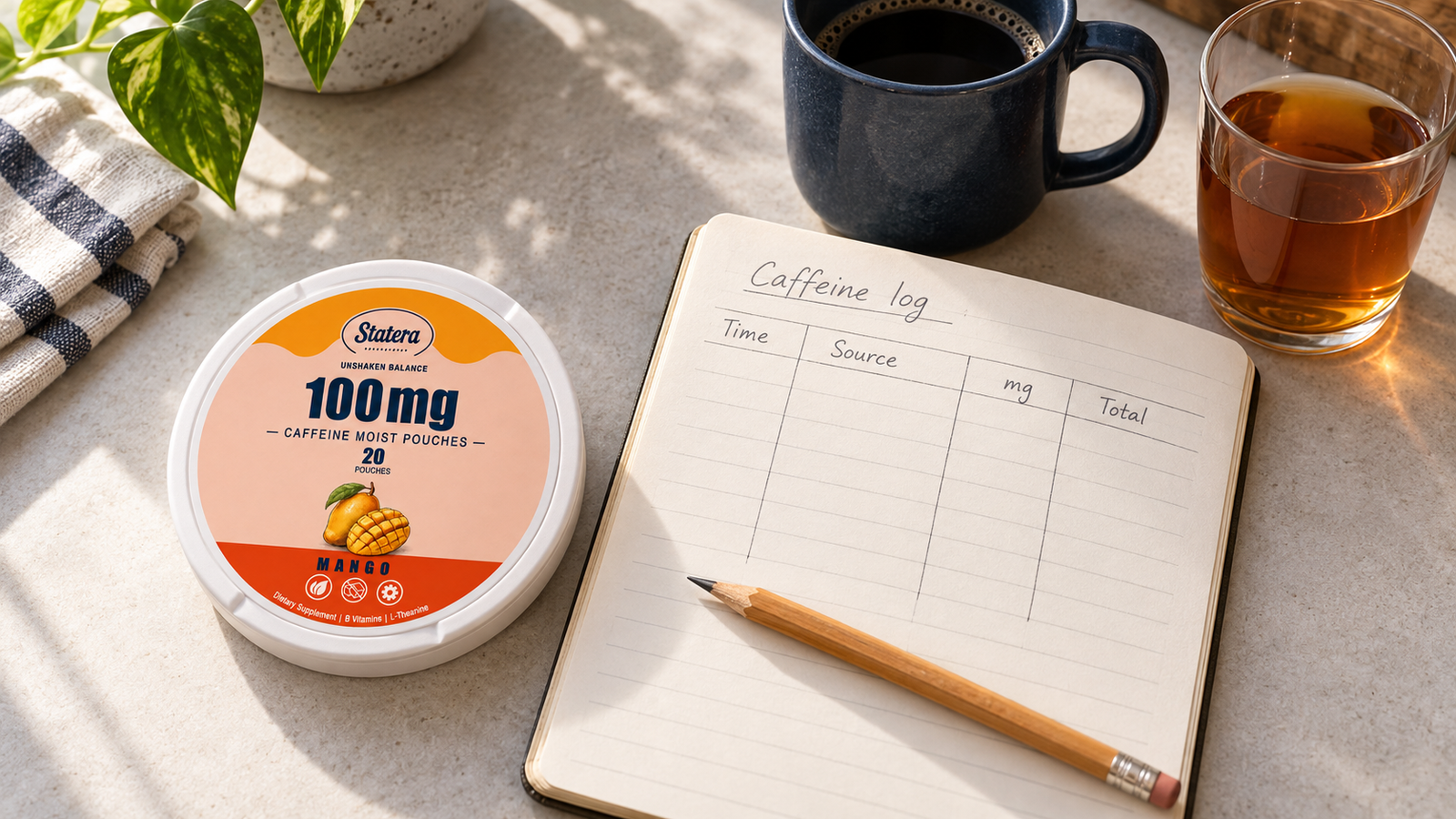
Coffee at breakfast. A pouch after lunch. Tea that barely registers as another caffeine choice.
Remembering the products is easier than remembering the milligrams. To track daily caffeine intake, record each source, the portion actually used, its caffeine amount and the time. Add each entry to a running total, and mark estimates as estimates. A paper note is enough.
The useful result is a record you can check later, not a number that looks impressively precise.
Give Each Caffeine Moment Its Own Line
Start with four fields: time, source and portion, caffeine in milligrams, and running total. Keep the product name or a label photo nearby if you need to check the figure again.
A refill gets another line. So does a pouch. If you finish the rest of a drink later, record that remaining portion without counting the whole container twice. A note made while the package is still in front of you is usually easier to reconstruct than a list assembled that evening.
This is a simple arithmetic example using an imaginary record, not a recommended combination, schedule or daily intake. The coffee and tea values are estimates; the pouch value is its labeled caffeine content.
| Time | Source | mg added | Total mg |
|---|---|---|---|
| 08:00 | Coffee 200mL | ~90 | ~90 |
| 12:30 | STATERA 1 pouch | 100 | ~190 |
| 14:30 | Black tea 220mL | ~50 | ~240 |
The beverage estimates come from EFSA’s reference examples: filter coffee at about 90mg per 200mL and black tea at about 50mg per 220mL. Here, the pouch is the current STATERA Mango 100mg pouch. Different drinks or labels require different entries.
Notice the approximation sign stays in the total. Adding a labeled 100mg to an estimated 90mg does not make the result exact.
Translate the Label Before Adding It
Check what the caffeine number refers to. Per pouch, per serving, per bottle and per 100mL are different starting points.
For a drink labeled per 100mL: multiply that caffeine figure by the volume consumed, divided by 100. For example, a hypothetical label showing 32mg per 100mL would give 80mg for 250mL: 32 × 250 ÷ 100. That is a label-math example, not a standard value for every energy drink.
For a product labeled per serving: multiply by the number of labeled servings used. Check the serving definition before treating one scoop or one container as one serving. For powders, follow the manufacturer’s measuring instructions rather than estimating a scoop by eye.
For caffeine pouches: enter the labeled milligrams for each pouch used. For tracking, keep that label-based amount in the record; do not invent a discount because a pouch was removed sooner. This log records product amounts, not measured caffeine absorption.
The STATERA label guide explains where to find the per-pouch figure. Once you have it, the tracking job is just to carry that unit consistently into the log.
Leave Unknowns Visible
Sometimes the café cannot provide a caffeine figure, or the package names caffeine without disclosing an amount. Write “unknown” beside the item instead of entering zero.
Use product-specific information when available. Otherwise, a clearly labeled estimate from an authoritative reference can be useful. Keep its serving size attached. Our 100mg caffeine context article compares specific beverage portions if you need a reference; a generic “cup” is too vague.
If one entry is a range, carry both ends through the addition. If an entry has no usable estimate, label the result “known subtotal + unknown item.” That small piece of honesty is more valuable than a tidy but incomplete total.
Check beyond drinks, too. The FDA’s caffeine guidance identifies possible sources including gum, bars, supplements and some over-the-counter medicines. Decaf coffee and tea can still contribute caffeine. Check your actual products; their names alone will not supply the amounts.
A Running Total Is Not a Countdown
Keep the time column even after the arithmetic is finished. It lets you see when entries clustered together or moved closer to bedtime.
EFSA notes that 100mg may affect sleep in some adults, especially near bedtime. A daily log cannot calculate how much caffeine remains in your body. Do not subtract milligrams from the intake record as the hours pass, or interpret a new calendar date as a physiological reset.
The FDA cites 400mg per day as an amount generally not associated with negative effects for most adults, while emphasizing individual variation. It is not a target or permission to add another serving. Pregnancy, breastfeeding, medications and medical conditions call for personal advice from a qualified healthcare professional.
Keep the Note Useful Tomorrow
At the end of the day, check for refills, unfinished drinks and any entries still marked unknown. Save the labels that supplied your numbers. You now have something more useful than “a couple of coffees”: a record whose assumptions are visible.
A notebook, spreadsheet or phone note can all do this. Choose the one you will actually update. Copy the four fields for the next day, but fill in what happened rather than repeating yesterday’s entries automatically.
For STATERA, use the strength printed on the exact can in hand. Current options are in the product collection. The log should follow your actual products, not the example above.
STATERA caffeine pouches are intended for adults only. Follow the product label and directions. This article provides general information, not personal medical advice.
STATERA Editorial Team
—Content StrategyThe STATERA Editorial Team brings you insights on energy innovation, market trends, and wellness strategies for modern retailers and consumers.
Related Articles
How Long Should You Keep a Caffeine Pouch In?
STATERA’s current directions say up to 20 minutes. Learn what that interval means, why removing a pouch is not a caffeine reset, and when to stop earlier.
Is 100mg of Caffeine a Lot? Putting the Number in Context
See how 100mg compares with specific servings of coffee, espresso, tea and energy drinks—and why portion size, timing and sensitivity matter.
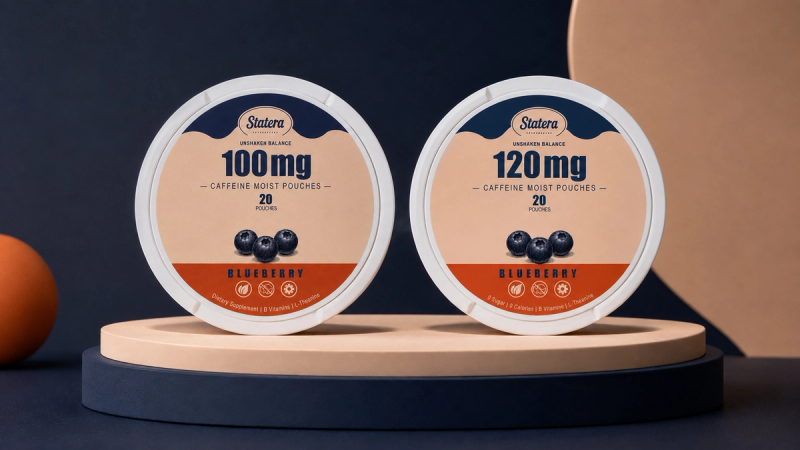
100mg vs 120mg Caffeine Pouches: What Actually Changes?
STATERA 100mg and 120mg caffeine pouches differ by 20mg per pouch. See the math, the current product labels and what to compare next.